Marketing funnels for creators: a simple 4 stage guide
Imagine pouring water into a funnel. You start with a lot at the top. Only a little comes out the bottom.
Marketing works the same way.
Thousands of people might see your content. Hundreds might get curious. Dozens might consider buying. A few actually will.
This is the marketing funnel. It's not complicated. But understanding it changes how you think about growing your business.
The 4 stages of a marketing funnel
Every customer goes through four stages before they buy. Marketers call these TOFU (top of funnel), MOFU (middle of funnel), and BOFU (bottom of funnel).
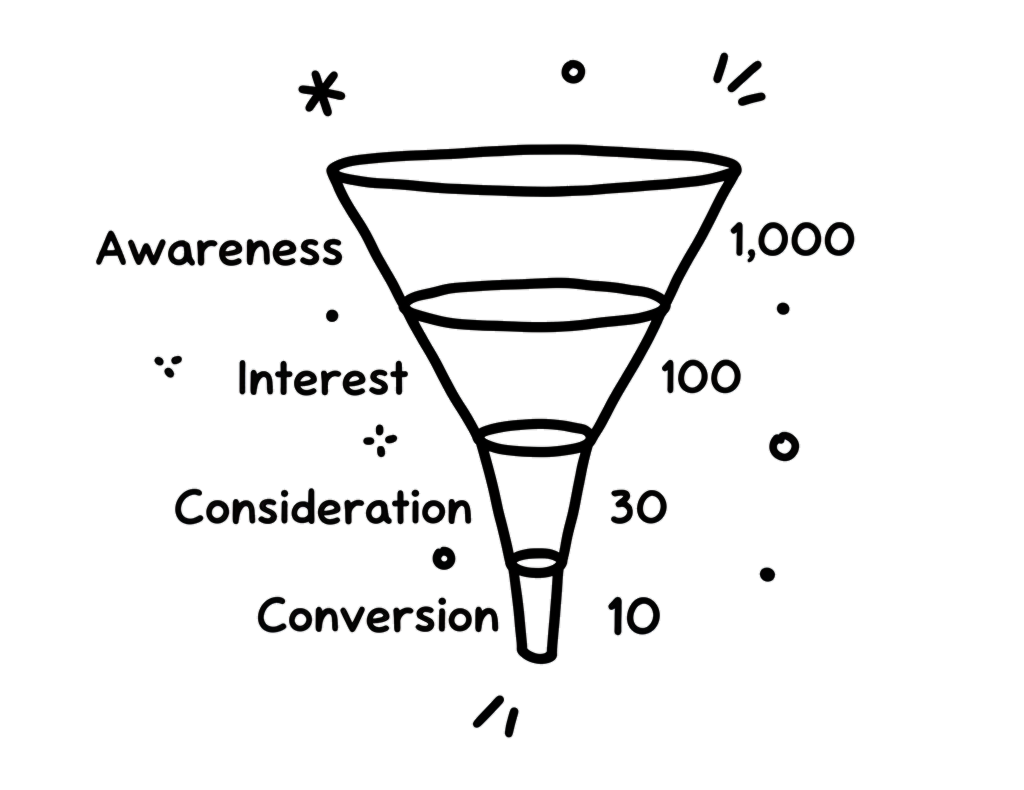
Awareness is when someone first discovers you exist. They saw a video. They read a tweet. They stumbled across your website. They know your name now. That's it.
Interest is when they want to learn more. They follow you. They read your bio. They click through to your page. Something caught their attention.
Consideration is when they're thinking about buying. They're comparing options. Reading reviews. Wondering if this is right for them.
Conversion is when they actually buy. Credit card entered. Transaction complete. They're now a customer.
The numbers shrink at each stage. That's normal. That's the funnel.
Why creators can't ignore the funnel
Most creators make the same mistake: they try to sell to people at the top of the funnel.
Someone discovers your content for the first time. You immediately pitch them your course. They scroll away. Of course they do. They don't know you yet. They don't trust you. Why would they buy?
The funnel explains why this fails. You can't skip stages. People need to move from awareness to interest to consideration before they're ready to convert.
Your job is to help them move through each stage. Not to drag them to the bottom before they're ready.
Marketing funnel example for course creators
Let's say you're launching an online course.
Awareness: You post content on social media. Short videos, tips, insights. People discover you. They've never heard of you before. Now they have.
Interest: Some of those people want more. They follow you. They join your email list. They're paying attention now.
Consideration: You share more about your course. What's in it. Who it's for. Success stories from early students. They're thinking about whether it's right for them.
Conversion: You open enrollment. They've been following you for weeks. They trust you. They know what they're getting. They buy.
Each stage prepares them for the next. Skip a stage and the whole thing breaks.
What are good funnel conversion rates?
Look at the funnel image again. 1,000 people become 100 become 30 become 10.
That's a 1% overall conversion rate. Is that good? For cold traffic, yes. Actually, that's quite good.
Here's what matters: the percentages between each stage.
If 1,000 people see your content and only 10 get interested, you have an awareness problem. Your content isn't resonating.
If 100 people are interested but only 5 consider buying, you have an interest problem. You're not building enough trust.
If 30 people consider buying but only 2 convert, you have a consideration problem. Your offer isn't compelling enough.
The funnel shows you where to focus. Instead of guessing why sales are low, you can identify exactly which stage is broken.
How to grow your funnel
Once you understand the funnel, you see there are only two ways to grow:
Get more people in the top. More awareness. More content. More reach. If 1% of people convert, then getting 10,000 people into your funnel instead of 1,000 means 10x more customers.
Improve the conversion at each stage. Better content that builds interest. Better nurturing that builds trust. Better offers that drive action. If you can turn that 1% into 2%, you've doubled your business without reaching a single new person.
The best businesses do both. But when you're starting out, improving conversion usually gives you faster results. It's easier to get better at nurturing 100 people than to reach 10,000 new ones.
How waitlists fit into your marketing funnel
A waitlist is your tool for the middle of the funnel.
Someone discovers you (awareness). They're curious about what you're building (interest). They sign up to learn more.
Now you can nurture that relationship. Send updates. Share your progress. Build trust over time.
When you're ready to launch, they've moved from interest to consideration to ready-to-buy. The funnel did its job.
This is why building an audience before you launch matters so much. You're not just collecting emails. You're moving people through the funnel so they're ready when you are.
Keep it simple
The funnel isn't magic. It's just a model for how people make decisions.
Strangers become aware of you. Some get interested. Fewer consider buying. Even fewer actually buy.
Your job is to:
- Get discovered by the right people
- Give them reasons to stay interested
- Build enough trust that they consider buying
- Make an offer worth saying yes to
That's it. Four stages. One framework. Everything else is details.
Start building your funnel today
LaunchSoon helps you capture interest and nurture early supporters before you launch. Build a beautiful, mobile-first waitlist page in minutes and start moving people through your funnel.